
17 November 2026 · info.fixtechsolution@gmail.com
Filer vs Non-Filer Bank Transaction Tax Rates in Pakistan
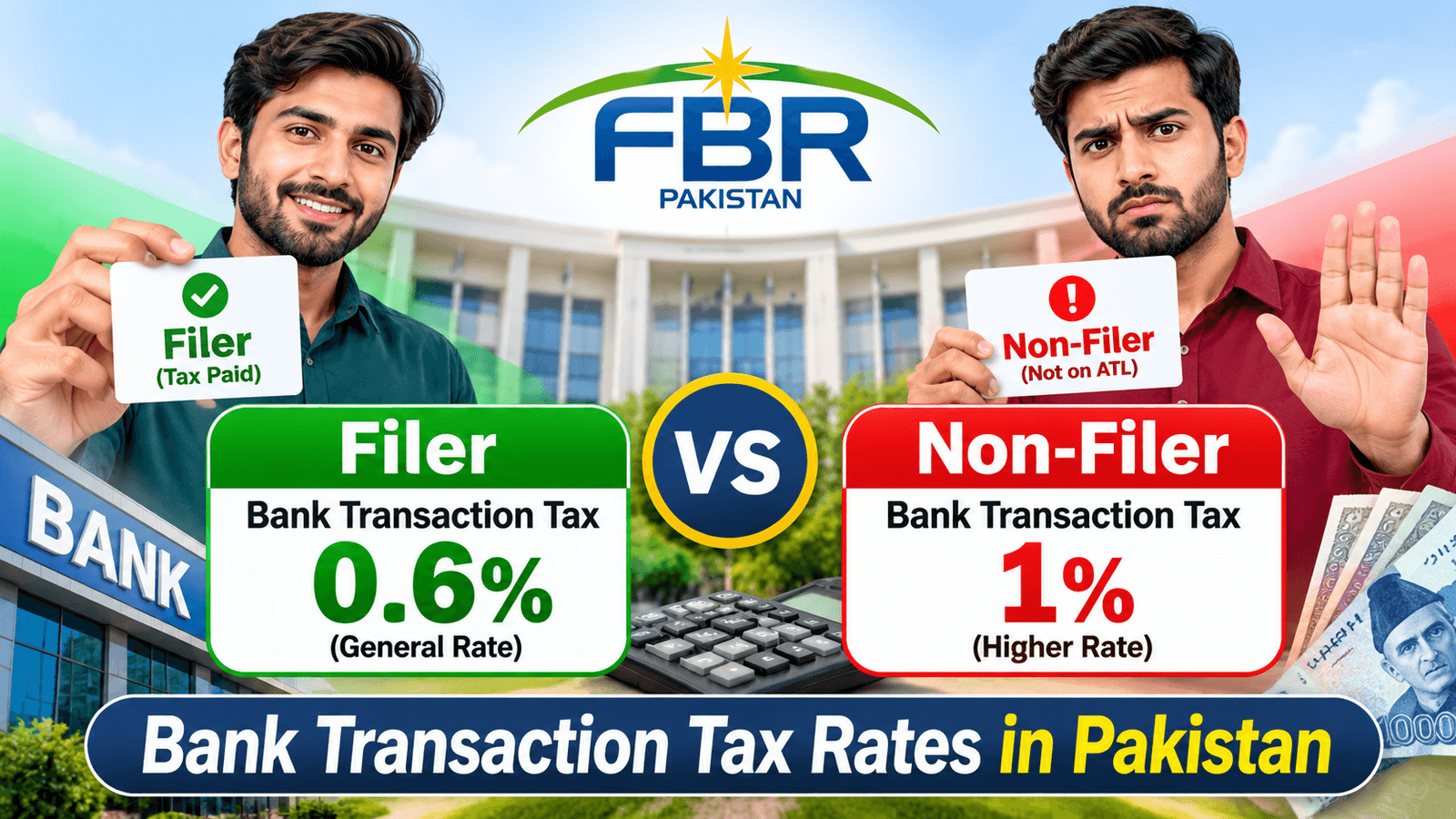
Ever noticed a deduction on your statement after a large cash withdrawal? That deduction depends on whether you are on the Active Taxpayer List. Understanding Filer vs Non-Filer Bank Transaction Tax Rates in Pakistan helps you plan withdrawals, avoid surprise deductions and make better financial decisions. This guide explains Filer vs Non-Filer Bank Transaction Tax Rates in Pakistan in plain language and shows how 7Pay fits into a smarter payment routine. It is general information, not tax advice, so confirm current rates with FBR or a tax professional.
Filer vs Non-Filer Bank Transaction Tax Rates in Pakistan: The Short Answer
The main tax most customers face is a charge on cash leaving the bank, and it applies only to non-filers.
Under Section 231AB of the Income Tax Ordinance, banks deduct advance tax when a non-filer’s cash withdrawals in one day go above Rs 50,000. Recent FBR rate information for 2026 shows 0.8 per cent for non-filers, while filers on the Active Taxpayer List pay nothing on the same withdrawal. Rates and thresholds can change with each Finance Act, so check the current figure before you act.
What Is the Active Taxpayer List?
The Active Taxpayer List, or ATL, is the Federal Board of Revenue (FBR) register of people and businesses who filed their income tax returns.
ATL taxpayers are treated as filers and get lower withholding rates across many transactions. Non-ATL taxpayers are non-filers, and they usually face higher rates. Your status is checked against the FBR list when the bank processes the transaction, so the rate depends on your status and not on which bank you use. You can read our guide on how to check your status with your CNIC if you are not sure where you stand.
Why Filer vs Non-Filer Bank Transaction Tax Rates in Pakistan Differ
The difference is deliberate, and it is meant to push people into the tax net.
The Income Tax Ordinance Pakistan uses higher withholding rates for people who have not filed, because the government wants more people to file a return and stay on the ATL. These FBR tax regulations apply across the Pakistani banking system, from cash withdrawals to profit on savings. Whenever you study Filer vs Non-Filer Bank Transaction Tax Rates in Pakistan, remember that the goal is compliance, and the practical effect is a tax exemption for filers on certain transactions.
Filer vs Non-Filer Bank Transaction Tax Rates in Pakistan: Comparison Table
This table gives you a clear side-by-side view of how the two statuses are treated.
| Transaction | Filer (ATL) | Non-Filer (Non-ATL) |
| Cash withdrawal above Rs 50,000 in a day (Section 231AB) | Exempt, 0% | Advance tax at the current rate, reported as 0.8% for 2026 |
| ATM cash withdrawal | Same rule as above | Same rule as above |
| Over-the-counter cash withdrawal | Same rule as above | Same rule as above |
| Cheques, pay orders and ordinary online transfers | Not covered by this cash tax | Not covered by this cash tax |
| Profit on bank deposits | Lower withholding rate | Higher withholding rate |
The first rows show the Cash Withdrawal Tax for Filers in Pakistan and the Cash Withdrawal Tax for Non-Filers in Pakistan side by side. Rates for profit on deposits differ by status and change often, so confirm the current figure with FBR or your bank.
ATM and Over-the-Counter Withdrawals
The tax follows the cash, and not the place you take it from.
ATM cash withdrawal tax and over-the-counter cash withdrawal are treated the same way under Section 231AB. What matters is your daily total of cash taken out. Your bank also sets its own daily cash withdrawal limit, which is separate from the tax threshold, so a withdrawal can be allowed by the bank and still be taxed if you are a non-filer. Banking transaction charges, such as a fee for a particular service, are also different from tax.
How the Deduction Works: An Example
A simple example shows how the numbers work.
Suppose you are a non-filer and withdraw Rs 200,000 in cash in one day. At 0.8 per cent, the advance tax would be Rs 1,600, and banks commonly apply the rate to the whole withdrawal once the daily threshold is crossed. A filer withdrawing the same amount would pay no tax. Your statement shows the exact deduction, so check it against the current rate. This is the Non-Filer Bank Withdrawal Tax Rate in practice, and it is why the Filer Bank Withdrawal Tax Rate of zero matters.
Is the Tax Adjustable?
The deduction is an advance tax, which means it is not always a final cost.
Withholding tax on cash withdrawal is generally treated as advance income tax, so it can be adjusted against your annual liability when you file a return. In practice, this means the deduction may be credited to you, though the treatment depends on your income and circumstances. Because the rules are technical, speak to a tax professional if you have large or frequent withdrawals.
How to Check Your Filer Status and Your Statement
Two quick checks tell you where you stand.
- Check your ATL status: use FBR’s official taxpayer verification tool with your CNIC to see whether you are on the list.
- Check your statement: a tax deduction from a bank account usually appears as a separate line next to the withdrawal.
- Check the dates: the ATL is updated periodically, so a recent filing may take time to show.
- Ask your bank: the branch or helpline can tell you the rate applied to a specific withdrawal.
Whenever you review Filer vs Non-Filer Bank Transaction Tax Rates in Pakistan, start with your own status, since it decides which column of the table applies to you.
How to Avoid Extra Withdrawal Tax Legally
There are lawful ways to reduce the impact, and the best one is to become a filer.
- File your income tax return so that you join the ATL and become exempt from Section 231AB.
- Use non-cash methods such as bank transfers, cheques and digital payments for large payments.
- Plan large withdrawals with your tax position in mind instead of relying on cash by default.
- Keep records of your income and withdrawals, so that you can claim any adjustment.
- Talk to a tax advisor if you run a cash-heavy business.
This is the legal answer to how to avoid extra bank withdrawal tax. Moving to digital payments also helps traders and families who handle a lot of cash. It matters for any business owner studying Filer vs Non-Filer Bank Transaction Tax Rates in Pakistan, since daily cash habits can add up to a large annual cost.
How 7Pay Supports Your Digital Payment Needs
Many everyday payments do not need cash at all.
At 7pay.com.pk, you can handle bill payments, mobile recharge and other digital payments from your phone, which reduces how much cash you need to withdraw. 7Pay does not set or change tax rates, since that stays with FBR and your bank, but it gives you a practical way to keep routine payments cashless. If you are comparing Filer vs Non-Filer Bank Transaction Tax Rates in Pakistan, using digital payments for daily expenses is a simple way to keep cash withdrawals low.
FAQs
1. What is the bank transaction tax for filers in Pakistan?
Filers on the ATL are exempt from the Section 231AB cash withdrawal tax, so they pay no advance tax on cash withdrawals.
2. How much tax do non-filers pay on bank withdrawals?
Non-filers pay advance tax on cash withdrawals when the daily total exceeds Rs 50,000, with the rate reported as 0.8 per cent for 2026, so confirm the current figure.
3. What is the difference between filer and non-filer bank tax?
Filers are exempt from the cash withdrawal tax, while non-filers have it deducted by the bank.
4. How to check bank withdrawal tax in Pakistan?
Look at your statement for a separate tax deduction line and ask your bank for the rate applied.
5. How much tax is deducted from ATM withdrawals in Pakistan?
ATM withdrawals follow the same rule as other cash withdrawals, so the tax applies only to non-filers above the daily threshold.
6. What are the bank cash withdrawal tax rules for 2026?
Section 231AB applies to non-filers who withdraw more than Rs 50,000 in cash in a day, and recent FBR information reports a rate of 0.8 per cent.
7. Do filers pay tax on bank transactions in Pakistan?
Filers do not pay the Section 231AB cash withdrawal tax, although other taxes, such as on profit, may still apply.
8. How to avoid extra bank withdrawal tax legally?
File your return and join the ATL, use non-cash payment methods and plan large withdrawals with advice from a tax professional.
9. Do cheques and online transfers attract this tax?
Section 231AB targets cash withdrawals, so ordinary transfers and cheques are generally outside it.
10. Can the deducted tax be adjusted later?
It is generally treated as advance tax that can be adjusted against your annual liability, so keep records and consult a tax professional.
Conclusion
Knowing Filer vs Non-Filer Bank Transaction Tax Rates in Pakistan helps you avoid surprises and decide whether becoming a filer is worth it. Filers are exempt from the cash withdrawal tax, while non-filers see a deduction once their daily cash withdrawals cross the threshold. Check your ATL status, review your statements, use digital payments where you can and confirm rates with FBR before any large transaction.
Call to Action
Want to keep everyday payments cashless and simple? Visit 7pay.com.pk and explore 7Pay’s secure digital payment services today. A quick look at Filer vs Non-Filer Bank Transaction Tax Rates in Pakistan shows why going digital makes sense.